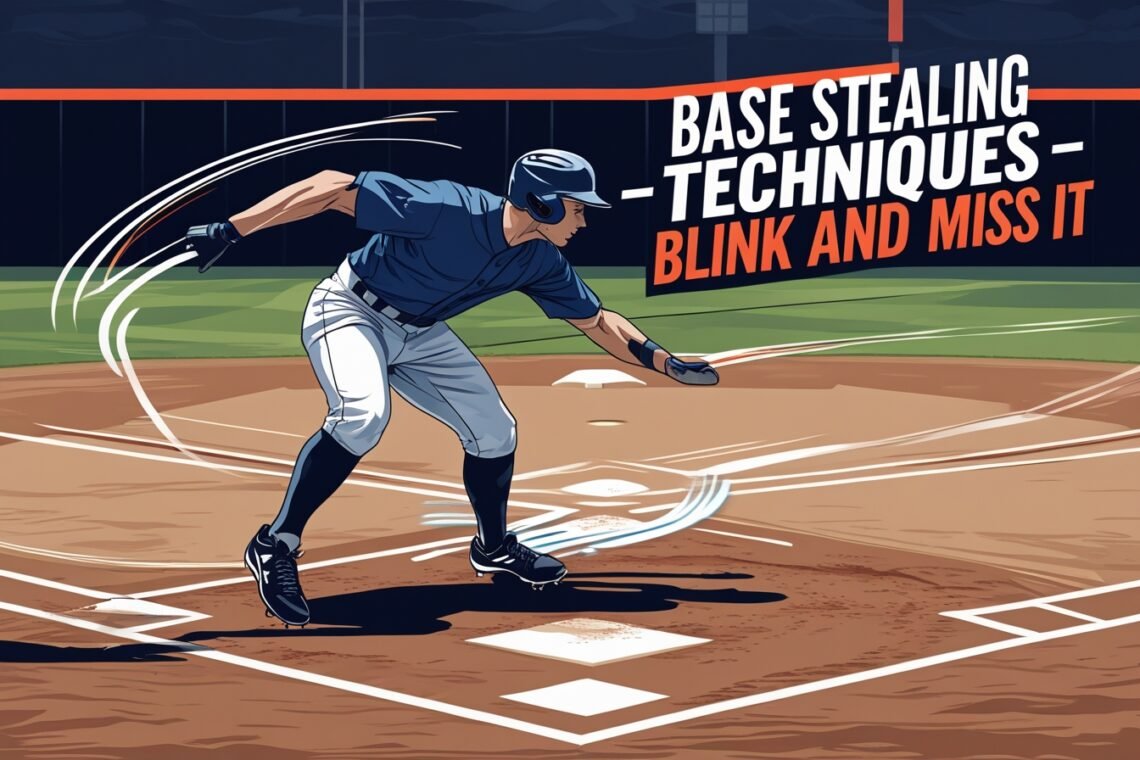
In the world of baseball, milliseconds separate heroes from zeros. Base stealing techniques can transform an ordinary runner into a lightning bolt that strikes before the defense can react. One moment you’re on first base, the next you’re sliding safely into second, and the opposing team is left wondering what just happened.
The Lightning Strike Mindset:
Base stealing isn’t just about speed; it’s about outsmarting your opponent before you even take your first step. The most successful base stealers understand that the battle begins in the mind, not with the legs.
Psychological Intimidation Through Presence:
Great base runners create anxiety in pitchers simply by taking their lead. Your presence alone should make the pitcher question every move, every timing, and every pitch selection. This mental pressure often leads to:
- Rushed deliveries that create stealing opportunities
- Distracted pitchers who lose focus on the batter
- Catchers who call for more fastballs to control the running game
- Defensive breakdowns due to overthinking
The key is establishing yourself as a constant threat without being reckless. Every shuffle, every lean, every glance toward the next base should send a message: “I’m coming, and you can’t stop me.”
Advanced Lead Techniques Beyond the Basics:
Traditional base-stealing advice focuses on standard leads, but championship-level runners master the art of deceptive positioning. This goes far beyond simply stepping off the bag.
The Phantom Extension Method:
This technique involves creating the illusion of a smaller lead while actually positioning yourself for maximum advantage. Instead of taking obvious steps away from the base, skilled runners use subtle body positioning to maximize their effective lead.
Your shoulders should face the next base while your feet remain in a seemingly conservative position. This creates a coiled spring effect where your first step explosively launches you toward your target. The pitcher sees a runner who appears under control, while you’re actually loaded and ready to strike.
Rhythm Disruption Strategies:
Successful base stealers break the pitcher’s timing by varying their lead patterns. Instead of mechanical movements, use irregular intervals between your lead adjustments. This keeps the pitcher guessing and prevents them from developing a comfortable rhythm.
Some runners take their lead immediately after each pitch, others wait several seconds, and the smartest ones mix these patterns unpredictably. This psychological warfare creates uncertainty that often results in slower deliveries to home plate.
Reading Pitcher Tells Like a Mind Reader:
Every pitcher has unconscious habits that telegraph their intentions. Master base stealers study these tells more intensively than poker players read their opponents.
Micro-Movement Detection:
Professional base runners focus on subtle indicators that most players miss entirely:
- Head positioning changes before pickoff attempts versus pitches home
- Shoulder tension variations between different types of throws
- Breathing patterns that indicate the pitcher’s next move
- Eye movement sequences that reveal intended targets
- Weight distribution shifts that precede specific actions
These micro-movements occur in the split second before the pitcher commits to their action, giving elite runners the advantage they need to time their jump perfectly.
Explosive First Step Mechanics:
The difference between safe and out often comes down to the quality of your first step. Championship base stealers don’t just run fast, they explode from their starting position like a drag racer off the line.
The Coiled Cobra Technique:
Your starting stance should resemble a cobra ready to strike. Weight slightly forward on the balls of your feet, knees slightly bent, arms in a balanced position. The moment you detect the pitcher’s commitment to home plate, you unleash stored energy in a coordinated explosion.
The first step should be a powerful drive step with your right foot (when stealing second), followed immediately by a crossover step that orients your body toward the target base. This sequence should happen so quickly that observers see one fluid motion rather than separate steps.
Power Generation Through Core Engagement:
Most runners focus only on their legs, but elite base stealers generate power from their core. Your midsection should fire like a spring, transferring energy through your legs and into explosive forward momentum.
Practice engaging your core muscles as you take your lead, creating internal tension that can be released instantly when you decide to go. This technique can shave crucial tenths of seconds off your steal time.
Advanced Sliding Strategies That Confuse Defenders:
A perfect base-stealing attempt can be ruined by poor sliding technique, while mediocre speed can be enhanced by masterful sliding skills.
The Decoy Slide Method:
Instead of committing to one sliding approach early in your sprint, maintain multiple options until the last possible moment. This keeps the fielder guessing about where and how you’ll arrive at the base.
Start your slide slightly early but in an ambiguous position that could develop into either a feet-first or head-first approach. As you read the defender’s positioning and the throw’s trajectory, commit to the sliding method that gives you the best chance of success.
Base Contact Optimization:
The best base stealers don’t just reach the base, they make contact in a way that minimizes tag opportunities. Your slide should aim for the back corner of the base furthest from the fielder’s position.
Use your hands to guide your body’s positioning during the slide, adjusting your angle based on where the defender is setting up for the tag. This real-time adjustment ability separates good runners from great ones.
Delayed Steal Mastery and Timing Deception:
Advanced base stealing includes techniques that don’t rely purely on speed but on timing manipulation and defensive confusion.
The Patience Paradox Approach:
Counter-intuitively, sometimes the best time to steal is when you appear to be taking a conservative lead. This delayed steal approach catches defenses off guard because it goes against conventional base-stealing wisdom.
Wait until the pitcher and catcher have relaxed into their normal rhythm, then break for the next base during a seemingly routine play. The element of surprise often compensates for the reduced head start.
Secondary Lead Exploitation:
Many runners ignore the opportunity presented by secondary leads, the additional steps you can take as the pitch travels to home plate. Expert base stealers maximize this secondary movement to create stealing opportunities even without perfect timing on their initial jump.
Practice taking optimal secondary leads that position you perfectly for a steal attempt on the next pitch, even if you didn’t go on the current one. This sets up multiple stealing opportunities within a single at-bat.
Silent Signals and Team-Based Stealing Coordination:
Team base stealing involves coordination that goes far beyond individual speed and technique. The most successful teams develop communication systems that allow for complex stealing strategies.
The Double-Steal Symphony:
Coordinated double steals require precise timing and clear communication between base runners. The runner on first base serves as the primary signal-caller, using subtle gestures to coordinate the attempt with the runner on second.
Common signal methods include:
- Hat adjustments to indicate readiness
- Specific lead-taking patterns that communicate timing
- Eye contact sequences that confirm go/no-go decisions
- Body positioning that indicates preferred steal counts
Batter-Runner Collaboration:
The most sophisticated base-stealing teams involve the batter in their stealing strategy. Batters can help runners by working counts that favor stealing (avoiding hit-and-run situations when a steal is planned) or by creating visual distractions that help mask the runner’s initial movement.
This three-way coordination between batter, runner, and coaching staff creates opportunities that individual efforts alone cannot achieve.
Environmental Factors and Situational Adjustments:
Professional base stealers adjust their techniques based on field conditions, weather, and game situations that recreational players often ignore.
Surface Speed Analysis:
Different field conditions require different approaches to base stealing. Wet conditions favor longer, more controlled slides, while dry, fast tracks allow for shorter, more aggressive slides.
Artificial turf creates different friction patterns than natural grass, affecting both your running stride and sliding approach. Elite runners scout field conditions during warm-ups and adjust their stealing strategy accordingly.
Game Situation Mathematics:
Strategic base stealing involves understanding the mathematical probabilities of different game situations. Late-inning steals in close games require higher success rates to be worthwhile, while early-game steals can be worth attempting with lower success probabilities.
Consider factors like:
- Inning and score differential
- Batter’s hitting tendencies and count work
- Pitcher’s fatigue level and control patterns
- Defensive positioning and the catcher’s arm strength
- Historical success rates in similar situations
Handling Failed Attempts and Mental Resilience:
Even the best base stealers get thrown out, but champions use failures as learning opportunities rather than confidence destroyers.
The Immediate Analysis Protocol:
After every steal attempt, successful or failed, conduct a quick mental review of what worked and what could be improved. This immediate feedback loop accelerates your development as a base runner.
Focus on specific elements like timing, first step quality, slide technique, and decision-making rather than general success or failure. This analytical approach builds confidence and improves future performance.
Confidence Rebuilding Strategies:
Failed steal attempts can create hesitation in future opportunities. Master base stealers have mental techniques to maintain aggression and confidence even after being thrown out.
Visualization techniques that replay successful steals can override the memory of failed attempts. Practice mental scenarios where you execute perfect steals to maintain the aggressive mindset necessary for continued success.
Conclusion:
Mastering base-stealing techniques transforms you from a passive runner into an active game-changer who controls the pace and pressure of every inning. The difference between average and extraordinary base runners lies not just in speed, but in the mental approach, technical precision, and strategic thinking that turn every steal attempt into a calculated strike against the defense.
FAQs:
1. What’s the most important factor in successful base stealing?
Timing your jump with the pitcher’s delivery to home plate is more crucial than pure speed.
2. Should I steal on the first pitch or wait for a better count?
Steal on counts that favor off-speed pitches like 1-1, 2-1, or 3-1 for slower delivery times.
3. How do I know if a pitcher is about to throw to first base?
Watch for subtle head movements, shoulder positioning changes, and leg lift variations that indicate pickoff attempts.
4. Is it better to slide feet-first or head-first when stealing second base?
Feet-first is safer and allows better last-second adjustments based on the fielder’s tag position.
5. What’s the success rate needed to make base stealing worthwhile?
You need at least a 75% success rate for stealing second base to benefit your team mathematically.
6. How can I improve my base-stealing speed without changing my running form?
Focus on explosive first-step mechanics and optimal lead distances rather than top-end running speed.